Concealer before or after foundation? The answer depending on the finish you're after
The eternal makeup question has a clear answer: it depends on the finish you want and your skin type. We'll tell you when it goes before, when it goes after and how to apply it without it cracking.
It’s one of those questions that comes up in any makeup conversation: does concealer go before or after foundation? The short, honest answer is that there’s no single answer. What there is, is a clear professional criterion depending on the finish you’re after and the skin type you’re working with.
In this article we’re going to sort this out once and for all. No dogma, no “always do it this way”: technique, logic and results.
The quick answer: it depends on the finish you want
If you want a natural finish, apply foundation first and then concealer only where you need it. You’ll use less product, the skin will breathe and you’ll avoid that mask effect that gives away makeup from three metres away.
If you’re aiming for maximum coverage —very marked dark circles, persistent redness, blemishes— you can apply concealer first on specific areas, blend it, and then extend the foundation over it. But watch out: this technique works best with light foundations, not high-coverage formulas that would drag the concealer around.
| Goal | Recommended order | Amount of product | Finish |
|---|---|---|---|
| Natural / rested skin | Foundation → concealer | Minimal | Luminous, second skin |
| Medium daily coverage | Foundation → concealer | Medium | Even, weightless |
| High coverage (marked dark circles) | Concealer → foundation → concealer | High | Polished, very covering |
| Mature or dry skin | Foundation → cream concealer | Minimal | Juicy, doesn’t settle |
| Oily / combination skin | Foundation → mattifying concealer | Medium | Controlled matte |
Concealer after foundation: the natural-finish school
This is the technique most makeup artists use in editorial and on the red carpet when they want real skin, not a filter. The logic is simple: the foundation already unifies the overall tone, so when you reach the concealer you find you need half the product you thought you would.
The result is cleaner, it cracks less throughout the day and it respects the skin’s texture. If your foundation is medium or high coverage, this is almost always the order you want.
How to apply it step by step
- Prep the skin with moisturiser and, if you use one, primer or prebase.
- Spread the foundation with a damp sponge or brush, in thin layers.
- Check what’s left to correct: dark circle, nostril wing, chin, any redness.
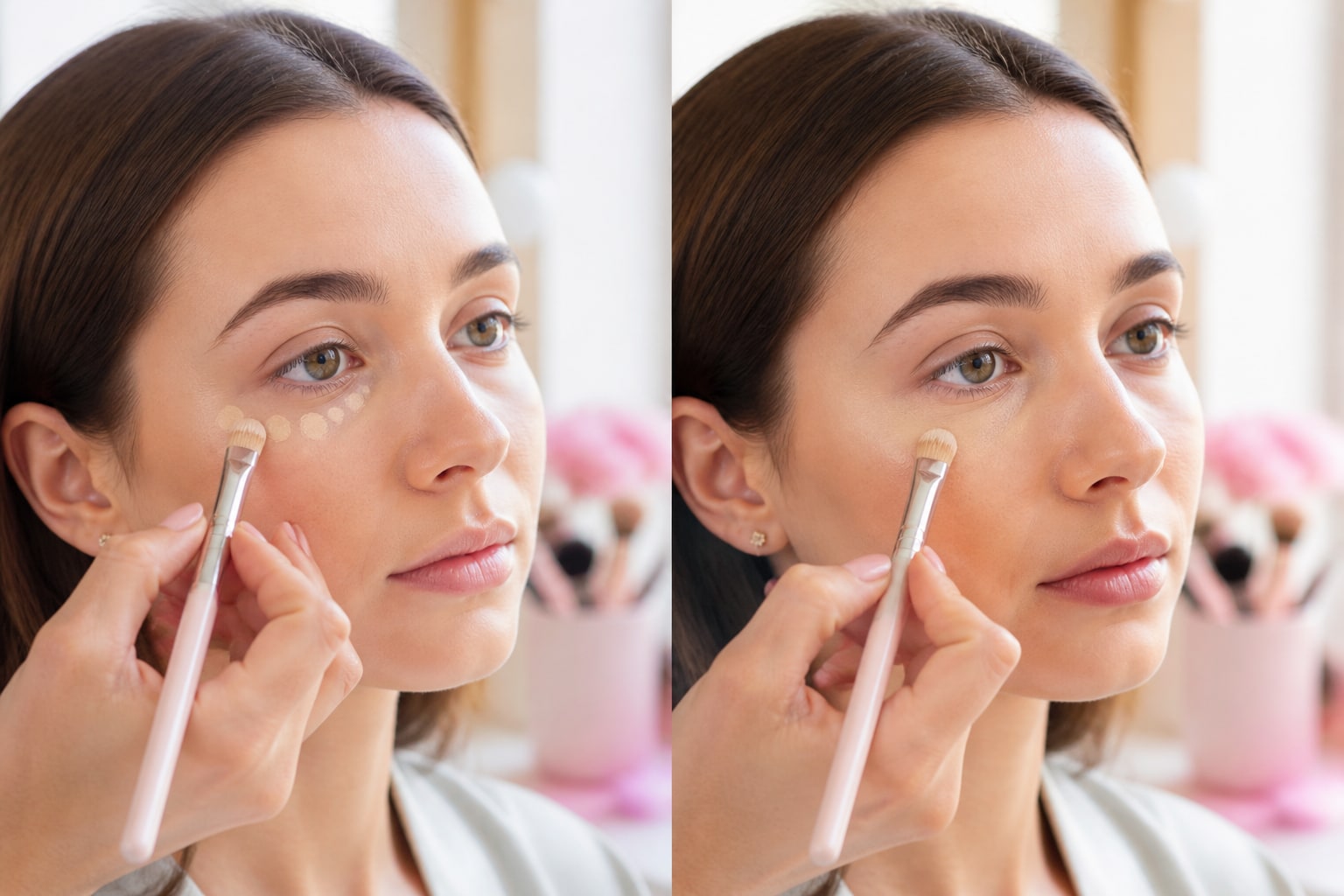
- Apply concealer only on those spots, with your ring finger or a small brush.
- Blend by tapping, never dragging.
- Set with a minimal veil of translucent powder only on the T-zone and under the eyes.
Concealer before foundation: when it makes sense
There are two scenarios where reversing the order works well. The first: highly pigmented dark circles that need a colour corrector (peach, orange) to neutralise before adding light. The second: localised redness —rosacea, recent acne marks— where a green or yellow corrector cancels the tone.
In both cases, you apply the corrector (the colour one), blend with a warm finger, and then pass the foundation over it with a sponge, tapping so you don’t drag it. If the dark circle or redness is still visible at the end, finish with a drop of concealer matching your skin tone.
What about mature and dry skin
Here the rule is clear: the less product, the better. Mature skin collects concealer in expression lines if you put it on before foundation, because when you then blend the foundation you drag product into the creases.
Always apply after, in a minimal amount, with a creamy, luminous concealer (nothing matte or powdered). A trick that works: mix a drop of concealer with a drop of moisturiser on the back of your hand before taking it to the face. It loses some coverage but gains in finish.
Oily and combination skin: the nuance of setting
If your skin shines mid-morning, the order is foundation first, concealer after, and strategic setting with powder only where needed. Applying concealer first multiplies the chances of it moving with the sebum.
Choose a mattifying liquid formula and avoid thick layers: two thin ones last longer than one thick one.
The mistakes we all keep making
- Applying concealer in an inverted triangle up to the cheekbone when you only need to cover the inner dark circle. Result: two light circles that scream “makeup”.
- Using a shade two points lighter than the foundation. One point is enough; anything beyond that gives a mask effect.
- Blending with a dry brush over dry skin. Always a warm finger or a damp sponge.
- Putting powder over all the concealer. Only under the eye, and very little.
The complete order, if you want the whole map
If what interests you is seeing where concealer fits within the full routine, we have a dedicated guide to the correct order for applying makeup step by step that saves you tests and mistakes.
So, before or after?
For 80% of days, faces and finishes: after. The foundation unifies, the concealer finishes and you use less product. Reserve “before” for correcting colour with specific correctors or for days of real high coverage.
The good news is that once you understand the logic, you stop asking yourself. You look at your skin, decide what finish you want today and the order comes naturally.