What is the most comfortable heel height for all-day wear?
Podiatrists agree: between 2 and 5 cm is the range that best absorbs body weight without punishing the sole of the foot. We tell you which heel to choose depending on how many hours you'll be on your feet, with both medical and style considerations in mind.
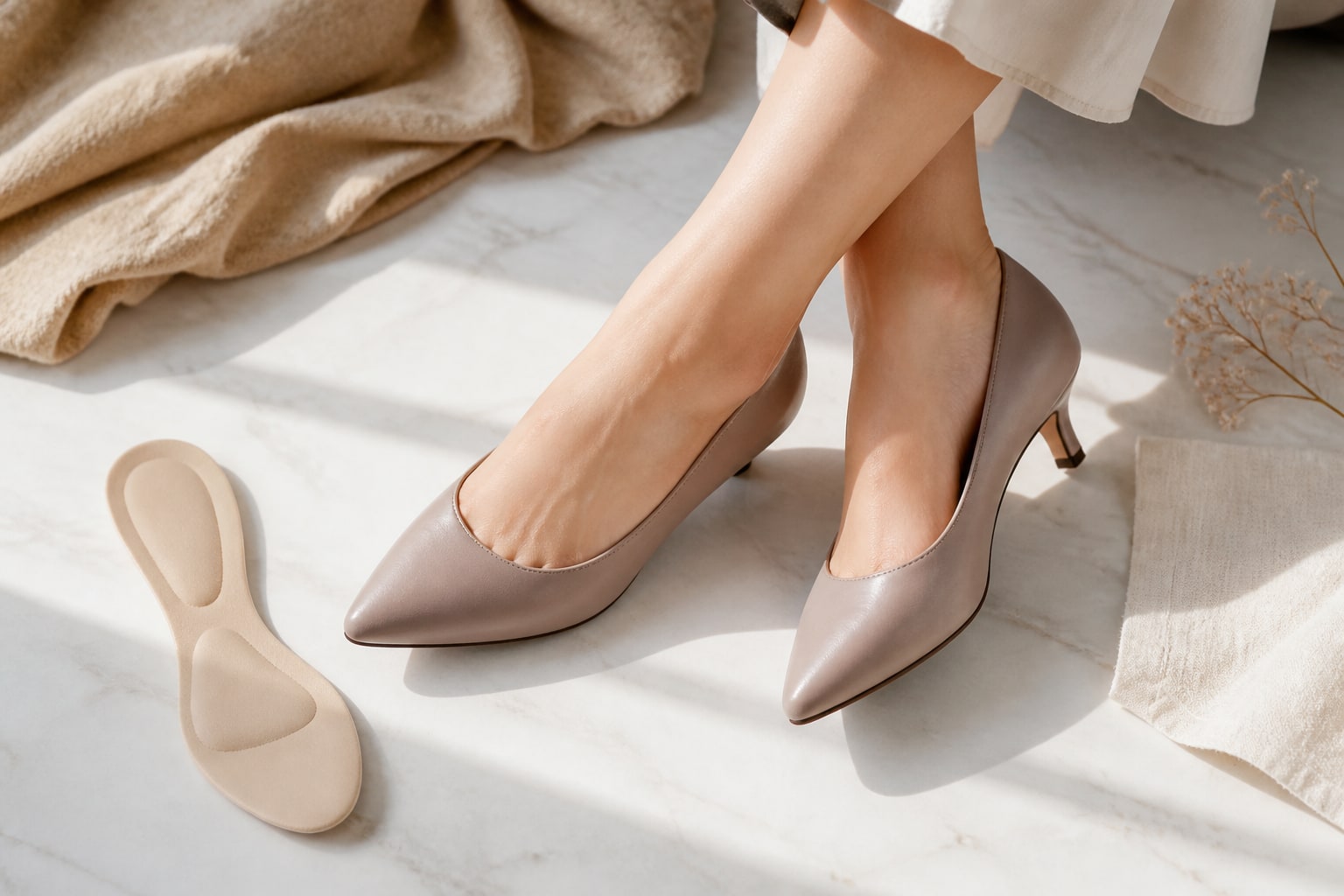
There’s a question we all ask ourselves before a wedding, a workday with an endless meeting, or a plan that starts at eleven in the morning and ends at midnight: how much heel can I handle today without regretting it? The short answer is that there is a specific range, endorsed by podiatrists, where the foot works in your favor rather than against you. The long answer has nuances of height, shape, materials and, above all, how many hours you’ll spend on your feet.
The range recommended by podiatrists: between 2 and 5 cm
The Spanish Society of Foot and Ankle Medicine and Surgery has been repeating the same thing for years: the healthiest height for daily use falls between 2 and 5 centimeters. Below 2 cm, a completely flat shoe isn’t ideal either (it fatigues the arch of the foot). Above 5 cm, weight progressively shifts toward the forefoot, and from 7 cm onward we’re talking about footwear for specific occasions, not for a full day.
That 2 to 5 cm range is the one that respects the foot’s natural curve, keeps the spine aligned and allows you to walk without altering your stride.
Quick table: height, recommended hours and ideal use
Here’s the summary you were probably looking for, with the maximum comfortable wearing time for each height.
| Heel height | Comfortable wearing hours | Ideal use |
|---|---|---|
| 0-1 cm (completely flat) | 4-6 h | Lots of walking, but fatigues the arch |
| 2-3 cm | 8-10 h | Office, full day, travel |
| 4-5 cm | 6-8 h | Daytime events, morning weddings |
| 6-7 cm | 3-4 h | Cocktail parties, dinners, brief red carpet |
| 8 cm or more | 1-2 h | Photos, arrivals and departures, no walking |
Why 3 cm is the magic height
If we had to choose a single figure, it would be 3 cm. It’s the height that slims the leg just enough, lifts the instep without shifting weight onto the metatarsals, and lets you walk briskly without wobbling. It’s also the classic height of loafers with a slight platform, Chanel-style slingbacks, and many well-made mid-calf boots.
At this height, the foot distributes weight roughly 60% on the heel and 40% on the forefoot, very close to the natural distribution (which would be 70-30 barefoot).
What happens when you go up to 7 cm or more
From 7 cm onward, the weight distribution reverses: up to 75% of the load shifts to the forefoot. That means crushed toes, metatarsalgia (that burning sensation under the toes) and, over time, possible bunions or neuromas. This isn’t alarmism: it’s physics.
This doesn’t mean you have to give up your stilettos. It means a 9 cm heel is for the event photo session, not for the full day.
The shape of the heel matters as much as its height
Two 5 cm shoes can be radically different depending on the base. Here’s what’s at stake:
- Wide or square heel: spreads the weight over more surface area. More stable, more comfortable.
- Block heel: the favorite of fashion editors for long days. Mary Janes, slingbacks, mules.
- Kitten heel: between 3 and 5 cm, slender but low. Elegant and bearable.
- Stiletto: all the pressure on a 1 cm point. Beautiful, but reserved for special occasions.
- Wedge: disguised height, continuous surface. Very comfortable for daytime.
- Platform: reduces effective height. An 8 cm shoe with a 2 cm platform is, in terms of incline, equivalent to a 6 cm one.
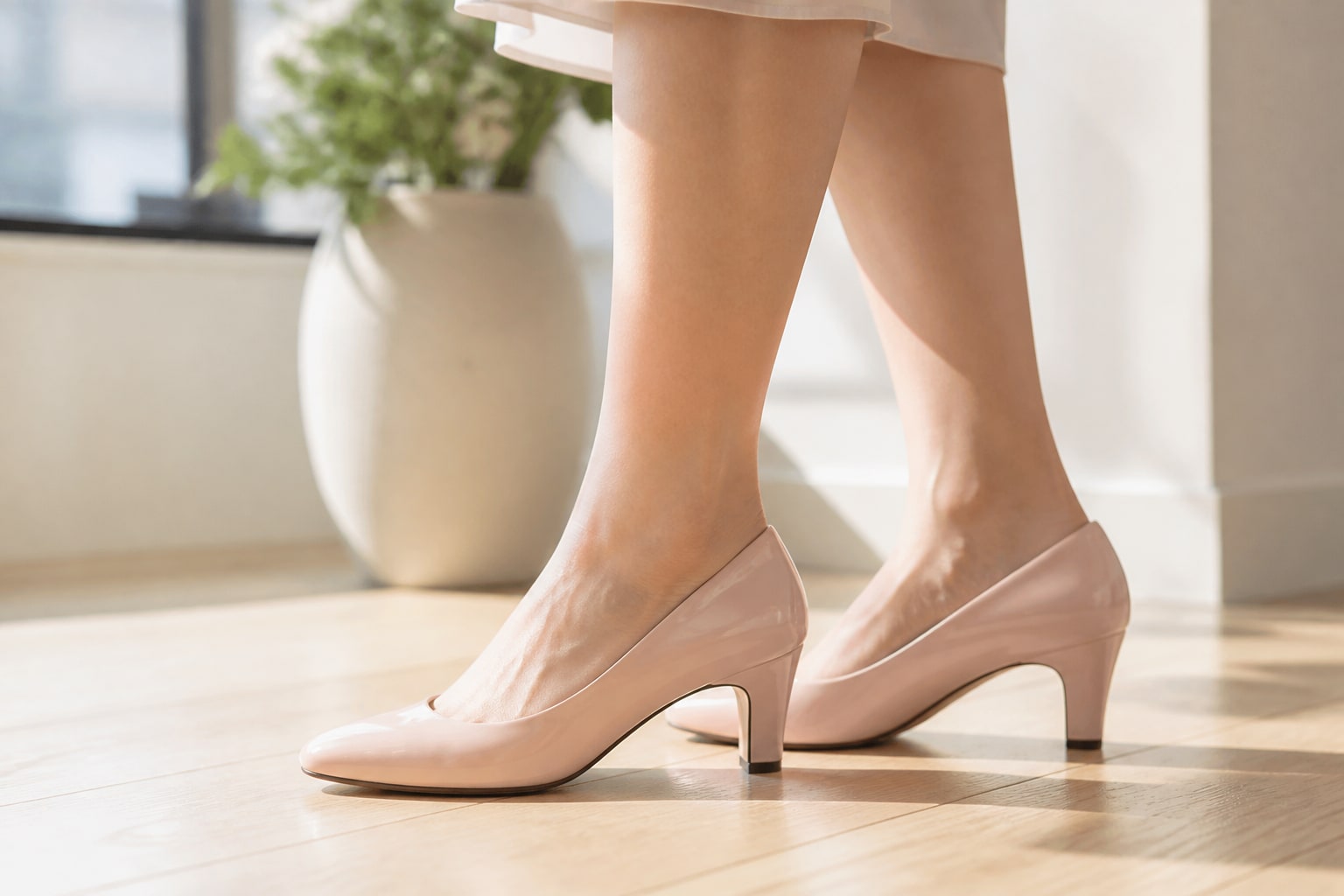
The platform trick: how to “cheat” height
If you fall in love with an 8 cm shoe but have twelve hours ahead of you, look for one with a front platform of 1.5 to 2 cm. The real incline your foot endures is the difference between both measurements. This is the logic behind the 1970s platform shoes and many of today’s party sandals from brands like Paris Texas or Gianvito Rossi.
Materials that add (or subtract) comfort
A good heel starts from the inside. What makes the difference:
- Padded insole: ideally latex or memory foam under the metatarsal area.
- Natural leather upper: it gives and adapts. Rigid synthetic doesn’t.
- Flexible sole: bend it by hand before buying. If it doesn’t give, your feet won’t either.
- Round or almond toe: leaves room for the toes. An extremely pointed tip is responsible for most blisters.
The brands getting the comfortable heel right
In the mid-range, Pretty Ballerinas remains unbeatable for 3-4 cm kitten heels from around €150. Mint & Rose works with 5 cm heights and very well-executed padded insoles. In the budget segment, the heeled loafers from Mango (around €50-60) and the slingbacks from Massimo Dutti (around €100) perform surprisingly well.
If we move up to luxury, the block heels from The Row or the slingbacks from Chanel justify their price in durability and in a last designed for real walking.
Which height to choose for each plan
- Office 9 to 6: 2-3 cm, heeled loafer or kitten heel.
- Full-day wedding: 4-5 cm with a wide base. Pack foldable ballet flats in your bag for after the dancing starts. If you’re unsure which footwear goes best with your dress, here’s our guide to shoes for a midi dress at an afternoon wedding.
- 2-3 hour cocktail party: up to 7 cm, stilettos allowed.
- Event with red carpet or photos: 8-10 cm, but assuming you’ll be standing still, not strolling.
- Trip or city break: 2 cm maximum, flexible sole.
The detail almost nobody measures: the angle of the instep
Two heels of the same height can have different inclines depending on how the last is cut. A short instep forces the foot to slide forward, crushing the toes. Before buying, check that the heel is held securely without squeezing and that you can move your toes comfortably. If you already feel pressure when trying them on, it won’t improve with wear.
Signs your heel is too high for that day
- You walk with your knees slightly bent.
- You feel a burning sensation under your toes before two hours have passed.
- You lean on walls or tables without realizing it.
- When you take them off, your toes take time to recover their position.
If any of these happen, the shoe isn’t meant for eight hours.
The conclusion in one sentence
For all-day wear, between 2 and 5 cm with a wide base, a discreet platform and a rounded toe. For everything else, a bag large enough to carry spare ballet flats, just as we carry the three handbags that go with everything. Elegance and rested feet aren’t mutually exclusive: you just have to choose the right shoe for each hour of the day.