How to tell good wool from bad wool in a coat? Five signs
A practical guide to knowing whether the wool coat you're about to buy will last you decades or just two winters. Five objective signs: label, feel, seams, drape and seals such as Woolmark.
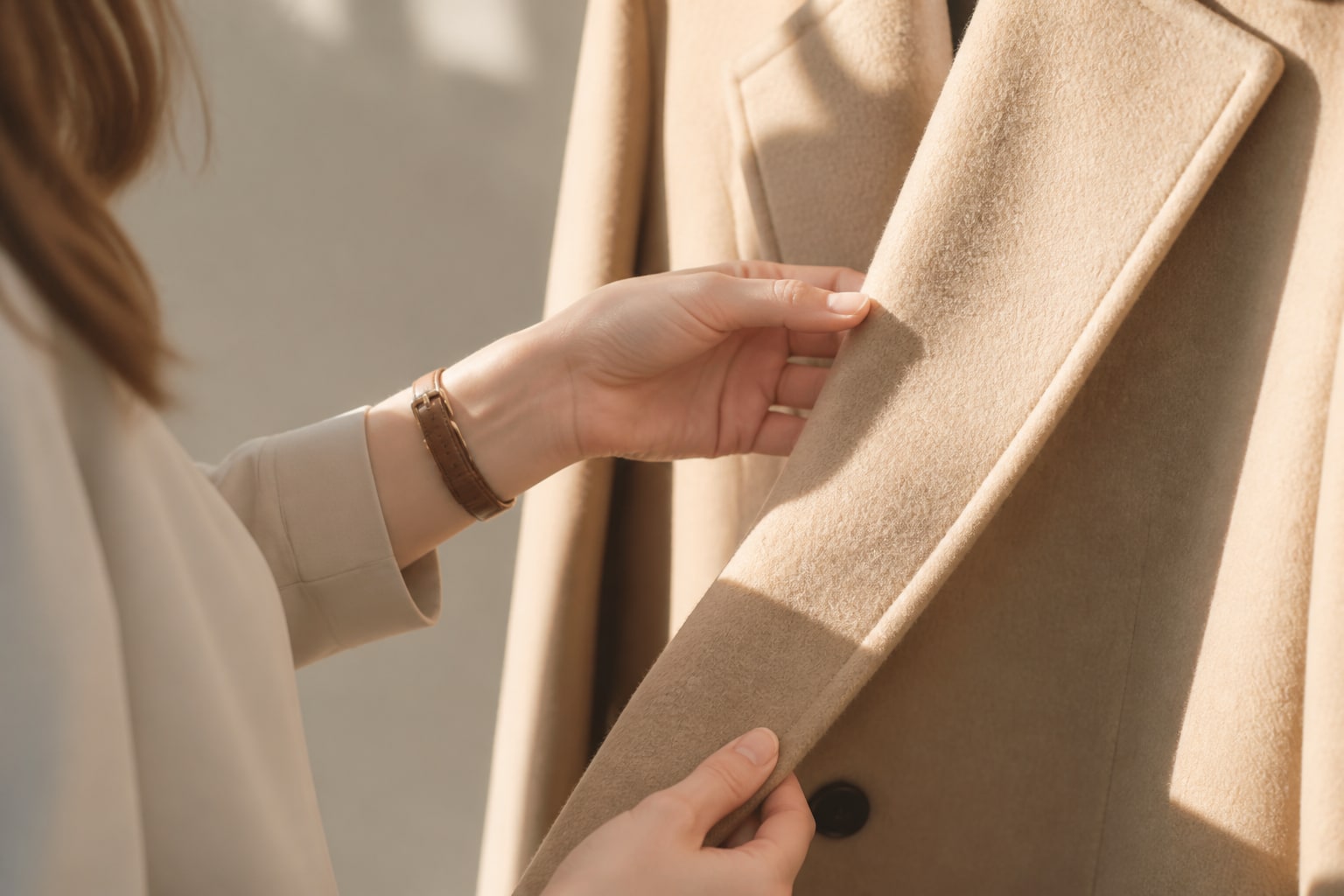
Buying a wool coat is one of those wardrobe decisions where it’s worth taking ten extra minutes in the fitting room. The difference between a good one and a mediocre one isn’t always obvious at first glance, but it shows after two winters: one keeps looking like it did on day one, while the other starts pilling, loses its shape at the shoulders and sags at the hem.
The good news is that you don’t need to be a textile expert to tell them apart. There are five objective signs, verifiable in the store and on the label, that tell you quite accurately what you’re dealing with. Let’s go through them.
Quick summary: the five signs of a quality wool coat
Before going into detail, here is the checklist you can save on your phone when you go shopping.
| Sign | What to check | Quality clue |
|---|---|---|
| Label | % of wool and type (virgin, merino, cashmere) | ≥ 70% wool, preferably virgin or merino |
| Feel | Softness, density, elasticity | Dense but flexible, recovers its shape when squeezed |
| Seams | Stitching, lining, shoulders | Straight, lining sewn (not glued), clean shoulders |
| Drape | Weight and how it moves | Hangs straight down, doesn’t bulge or “float” |
| Seals | Woolmark, Woolmark Blend, traceability | Woolmark = 100% certified virgin wool |
Now, the details.
1. The label: the first thing to read
It sounds obvious, but many people buy a “wool” coat without checking the actual percentage. And that’s the first trap.
In Spain, under European regulations, the label must state the exact composition. What you’re looking for:
- 70% wool or more to consider it a genuine wool coat.
- Ideally, it should specify virgin wool (first shearing, unrecycled fibre) or merino wool.
- If you see cashmere, mohair or alpaca, even better: they add softness and insulation.
- The rest is usually polyamide, polyester or viscose. A small percentage (up to 10-15%) helps with durability; beyond that, thermal quality and appearance begin to decline.
Warning sign: labels such as “60% polyester, 40% wool” sold as a wool coat. Technically they are, but in practice they insulate less, pill more and age worse.
2. Feel: what your hand tells you in two seconds
Touch the fabric with your open palm, not your fingertips. You should feel density without stiffness. Good wool is compact but flexible: if you pinch a fold and let go, it springs back almost instantly, leaving no mark or crease.
Signs of mediocre wool:
- Rough, dry feel (short, low-grade fibre).
- An artificial “padded” sensation, as if it were filled with air.
- When squeezed, it stays creased or marked.
- When you run your hand against the grain, loose fibres lift: that’s the prelude to pilling (pilling) after two weeks of wear.
Good merino is silky, cashmere is almost buttery, and dense virgin wool is firm and warm. None of the three should itch when you rest it against your neck.
3. Seams and interior: where the finishing hides
This is where the leap between a €150 coat and a €600 one shows, and where most buyers don’t look.
Turn the coat inside out and check:
- Straight, regular, small stitches. The tighter the stitching, the better the finish.
- Sewn lining, not fused. If the lining is glued to the fabric over large areas, that’s a bad sign: over time it peels away and forms bubbles.
- Clean shoulders, without odd folds. The shoulder is the hardest part to make; if it’s well resolved, the rest usually is too.
- Buttons sewn with thick thread and reinforced, not dangling from a thin thread.
- Finished buttonholes with no loose threads.
A trick: look at the inside of the collar. If it’s carefully interfaced and the seam is invisible, there’s craftsmanship behind it. If you notice rigid plastics or cardboard, it’s quick manufacturing.
4. Drape: how the coat behaves when you wear it
This is the easiest sign to see in the fitting room mirror, and the one that separates a pretty coat from a spectacular one.
A good wool coat hangs straight down. The weight of the fabric keeps the lapels in place, the hem hangs straight, and the shoulders keep their structured shape without exaggerated padding. When you walk, the coat moves with you with a certain elegant inertia; it doesn’t “float” or lift in the breeze.
Signs of a coat that won’t last the season:
- It feels suspiciously light (real wool has weight: a long coat weighs around 1.5-2.5 kg).
- The hem flares out or curls.
- The lapels don’t lie flat and need readjusting every ten minutes.
- When you sit down, it crumples like paper and takes ages to recover.
If you’re investing in a piece for years, remember that this is, literally, a timeless garment worth the investment: a good coat pays for itself over ten winters, not one.
5. Quality seals: Woolmark and others
The Woolmark seal (that black coiled skein) has been certifying wool since 1964. It isn’t decorative: it means the fibre has passed controls for purity, strength and traceability.
What distinguishes each version:
- Woolmark (classic logo): 100% certified virgin wool.
- Woolmark Blend: between 50% and 99.9% virgin wool; the rest meets quality standards.
- Wool Blend: blend with less than 50% certified wool.
It’s not the only reliable seal. Benchmark Italian brands such as Loro Piana, Agnona or Colombo don’t always display it, because their own traceability already works as a guarantee. If the coat is made from a recognised Italian fabric (you’ll see it on an interior label such as “Tissu fabriqué en Italie par…”), that’s a good sign.
And beware: the absence of Woolmark doesn’t mean bad wool. It means the brand hasn’t paid for the certification. But its presence is a quick guarantee when you don’t have more information.
So, how much does a wool coat worth buying cost?
For reference:
| Range | Approx. price | What to expect |
|---|---|---|
| Entry level | €150-250 | 60-70% wool, correct construction, lasts 3-5 winters |
| Mid-range | €300-600 | 80-100% virgin wool, good finishing, 7-10 years with care |
| Premium | €700-1,500 | Virgin wool, cashmere or noble blends, artisanal construction |
| Luxury | €1,500+ | Italian fabrics, pure cashmere, genuine investment pieces |
Brands such as Massimo Dutti and COS perform solidly in the mid-range. Max Mara remains the European reference for wool coats (the 101801 has been in production for decades for a reason). And at a more accessible level, Mango has some pieces each season with a decent wool percentage that exceed what their price suggests.
Last tip: try it on with what you’ll wear underneath
A good wool coat has to fit over a thick jumper without pulling at the shoulders or back. If you buy it fitted in short sleeves, you won’t wear it in January. A comfortable size is better than a perfect one in October: wool doesn’t give, doesn’t stretch out with use, and what you buy is what you’ll have for years.
Check the label, feel the fabric, inspect the seams, observe the drape and look for the seal. Five two-minute gestures in the fitting room that save you from a buyer’s regret and, hopefully, leave you with the coat you’ll wear for the next decade.