What is the difference between a blazer and a sport coat? A quick guide so you don't get confused
Blazer and sport coat are used as synonyms, but they are not the same garment. We explain how they differ, when to wear each one and how to combine them without getting it wrong.
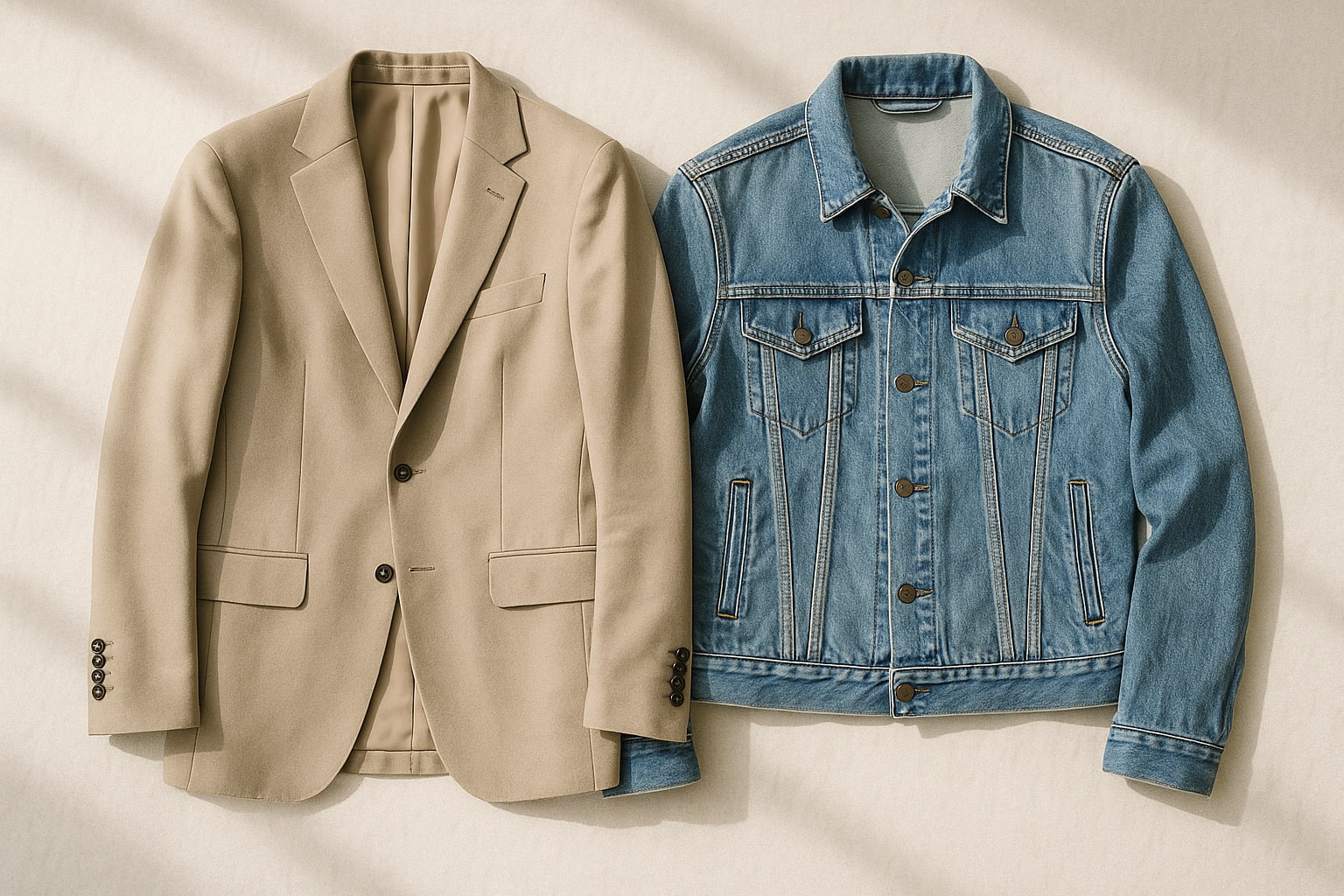
We use them interchangeably in the fitting room, on Instagram and even in some brands’ product listings. But if you have ever felt that “americana” sounds more like a suit and “blazer” more like a loose jacket, your instinct is on the right track. Although they share silhouette and structure, a blazer and a sport coat are not exactly the same garment, and knowing how to tell them apart helps you put together more precise looks, both for the office and for a dinner.
Here is the quick guide so you never doubt it again.
The confusion we all carry
In Spanish, and especially in Spain, “americana” has become a catch-all term for any structured tailored jacket. In English, however, the dominant term is blazer, and in Italy or France there is a clearer distinction between giacca da abito (suit jacket) and blazer.
The result is that many brands label as “blazer” what would technically be a sport coat, and vice versa. It is not a drama, but when you want to buy a jacket that matches a specific pair of trousers —or just the opposite, that works on its own— the difference matters.
Summary in 30 seconds
If you are in a hurry, this table resolves 90% of your doubts:
| Feature | Blazer | Sport coat |
|---|---|---|
| Origin | Sport jacket (yacht clubs, rowing) | Upper part of a two-piece suit |
| Sold with matching trousers | No | Yes (or designed to be) |
| Usual fabric | Flannel, twill, heavy wool, blends | Cool wool, tropical wool, suiting fabrics |
| Buttons | Metal or contrast, often gold | Same fabric or discreet tone |
| Formality | Medium (sport-chic) | High (formal / business) |
| Pairs with | Jeans, chinos, skirt, dress | Trousers of the same fabric and colour |
With this you can keep reading with judgement. Let’s get into the details.
What exactly a blazer is
The blazer was born in the late 19th century in British rowing clubs —the most cited is the Lady Margaret Boat Club of Cambridge, with its famous intense red— as a sporty uniform jacket. From there it moved to yacht clubs, with that navy version with gold buttons that we instantly recognise today.
By definition, it is a sport jacket. Structured, yes, but designed to be worn loose, without matching trousers. Its hallmarks:
- Metal buttons (gold, silver) or contrast ones (horn, mother-of-pearl).
- Fabrics with body: flannel, twill, heavy wool, even velvet in an evening version.
- Classic colours: navy, bottle green, burgundy, camel.
- A cut that accepts both fitted and oversize.
A blazer is that jacket you throw over a white T-shirt and straight-leg jeans and you’re sorted.
What exactly a sport coat is
The sport coat is, originally, the upper part of a two-piece suit (or three, if we add the waistcoat). It is called that in Spain precisely because of the influence of the American cut in the early 20th century, straighter and less fitted than the British or Neapolitan.
Its features:
- It is conceived to match trousers of the same fabric and colour.
- Discreet buttons, in the same tone as the fabric.
- Fine, flat fabrics: cool wool, tropical wool, blends with silk.
- Tailoring colours: charcoal grey, anthracite, black, midnight blue, plain camel.
- A cut designed to accompany the trousers, not to stand out on its own.
You can wear the sport coat loose (it is then called spezzato in tailoring slang), but its DNA is to form a suit.
The 5 differences that really matter
1. Fabric
The blazer uses fabrics with visible texture: flannel, diagonal twill, rough blends. The sport coat seeks smooth, uniform surfaces, typical of a suit.
2. Buttons
The quickest detail to identify them. Gold metal or contrast buttons = blazer. Discreet buttons in the same fabric = sport coat.
3. Formality
The sport coat is more formal by default. The blazer moves in the smart casual territory: elegant, but relaxed.
4. Cut
Both can be fitted or oversize, but the sport coat usually has more defined shoulders and a longer length (low hip). The blazer admits more variants: cropped, three-quarter, double-breasted nautical.
5. Combination
The sport coat asks for matching trousers —or at least of the same register— to shine. The blazer, the other way round: the more contrast with the bottom half, the better.
How to combine a blazer without getting it wrong
The blazer is the chameleon garment of the wardrobe. These are the combinations that always work:
- Navy blazer + straight-leg jeans + white shirt + loafers. The timeless uniform.
- Bottle green blazer + cream trousers + fine cashmere jumper. Very autumnal.
- Black velvet blazer + satin trousers + jewelled sandal. For a dinner.
- Camel blazer + midi dress + high boots. Perfect for mid-season, and if you are interested in the topic you will enjoy our guide on which skirts and dresses high boots pair best with this year.
It works better if you play with contrasting textures (structured blazer + fluid garment underneath). Avoid it if you intend to pair it with trousers of the same fabric: it will be obvious it is not a real suit and the effect will look messy.
How to combine a sport coat without getting it wrong
Here coherence is key. The sport coat works in two registers:
- In a full suit, with its matching trousers. Add a silk shirt, a lace blouse or even a fine combed-cotton T-shirt if you want to soften it. It is the winning formula for interviews and important meetings; you have more ideas in our piece on the look that speaks for you in a job interview.
- Loose (spezzato), combined with trousers of a different fabric but equivalent formality: grey sport coat with anthracite trousers, camel sport coat with chocolate trousers.
It works better if the trousers match in weight and drape. Avoid it if you are going to mix it with heavily washed jeans or sports trainers: the sport coat asks for thin-soled footwear (dress shoes, loafers, polished boots).
Timeless wardrobe staples: which ones you need
You don’t have to choose, but if you are starting from scratch:
- If your life is more office, meetings and formal events → sport coat (ideally as a suit, in charcoal grey or midnight blue).
- If your life is more mixed —creative work, afternoon plans, dinners, long weekends— → blazer (in navy with gold button, the most versatile).
- If you have room for both, that is the ideal scenario: you cover every register.
Both are a safe investment. Well cut, in noble fabrics and with tailoring adjustments made to your measure (shoulder, sleeve length, fit), they last season after season without going out of style.
A final note on labels
Don’t obsess over what the shop label says. Look at the five points we have seen —fabric, buttons, formality, cut, combination— and you will know what you have in front of you. In the end, what matters is that the jacket works with what is already in your wardrobe and with the life you lead, not the technical name. But now, when someone uses them as synonyms, you will know why they are not entirely the same.