How many white shirts should you have in your wardrobe? A lifestyle guide
The answer depends on your routine, but there is a clear range: between 2 and 6 white shirts depending on whether you work in an office, remotely, or combine both worlds. We explain how many you need and why.

It’s the question we all ask ourselves at some point in front of the wardrobe: is one white shirt enough, or do you need several? The short answer is that it depends on your weekly routine, but there is a range that works for most people: between 2 and 6 white shirts, depending on how often you wear them and in which contexts.
It’s not an arbitrary figure. It has to do with laundry rotation, with the real wear of white fabric (which yellows and turns sheer before any other color), and with the different registers we ask of this garment: the office is not the same as a casual lunch, and an evening event isn’t solved with the same shirt you use for working from home.
The short answer: a range based on your weekly routine
Before going into detail, here is the summary you were probably looking for.
| Lifestyle | Recommended white shirts | Weekly frequency of use |
|---|---|---|
| Full-time office, 5 days | 4-6 | 3-4 times |
| Hybrid (office + home) | 3-4 | 2-3 times |
| Remote / freelance | 1-2 | Occasional (meetings, events) |
| Busy social life (events, dates) | 2-3 | 1-2 times + emergency spare |
| Minimalist capsule wardrobe | 2 | Constant rotation |
This range is not fixed: if your job demands a very polished image (consulting, banking, client-facing roles), it’s wise to lean toward the upper limit. If your day-to-day is more casual, 2 quality pieces are more than enough.
Why the white shirt needs more units than other basics
Here is the key that many people overlook when thinking about women’s capsule wardrobe or basics in general: white shows dirt, and that speeds up its laundry cycle.
A navy shirt can go two or three wears between washes without it showing. A white one can’t. Sweat under the arms, neck friction, a drop of coffee: everything gets marked and is immediately visible. This means that if you wear it daily, you need more units in rotation so you don’t have to wash it constantly, because frequent washing is precisely what wears it down and yellows it prematurely.
That is why the question “how many basics do I need?” has a different answer for the white shirt than for a black sweater or jeans: here the deciding factor is not only use, but laundry rotation.
White shirt for the office: 4 to 6 units
If you work in an environment where the white shirt is almost an unwritten uniform—consultancies, law firms, banking, customer service—the range goes up.
With 4 shirts you can cover a work week alternating with other colors. With 6, you have room to wear one several days in a row without depending on the washing machine in between, which is useful if you travel for work or have a packed schedule.
This is where it’s worth investing in at least one basic white shirt from a noble fabric for your capsule wardrobe—good-density cotton poplin or a blend with some elastane so it wrinkles less—and completing the rest with mid-range options. Not all six need to be the same quality; but at least two should be, for the important days.
Casual white shirt: 2 or 3 is enough
For a more relaxed lifestyle—remote work, studying, days without fixed meetings—the calculation changes completely. Here the white shirt is not a daily uniform, but a versatile piece you bring out when you want a touch of white shirt for each occasion: a family meal, an important video call, a date.
With 2 or 3 casual white shirts, in lighter cotton or even a linen blend, you more than cover those occasional moments. There’s no point in accumulating more if they then hang unused: a white shirt that never rotates in the wardrobe tends to yellow anyway, simply through the passage of time and light.
White shirt for special occasions: the spare piece
There is a third category that is often forgotten: the “event” white shirt, reserved for occasions when you need to look impeccable with no margin for error. We’re thinking of an important work dinner, a presentation, or wearing it under a blazer for a more formal look.
For this, ideally you have one specific shirt, with a more structured cut and fabric with good drape (a heavier-thread poplin or a blend with silk), that you don’t use day to day. This way it stays impeccable and you avoid the risk that, on the day you need it, it’s stained or freshly washed and wrinkled.
If your plan is to pair it with a midi skirt or tailored trousers for a company dinner, it will help to review how the cocktail dress code works in 2026, because the white shirt is precisely one of the wildcard pieces that best solves that code when you don’t know what to wear.
Types of white shirt worth having (not all are the same)
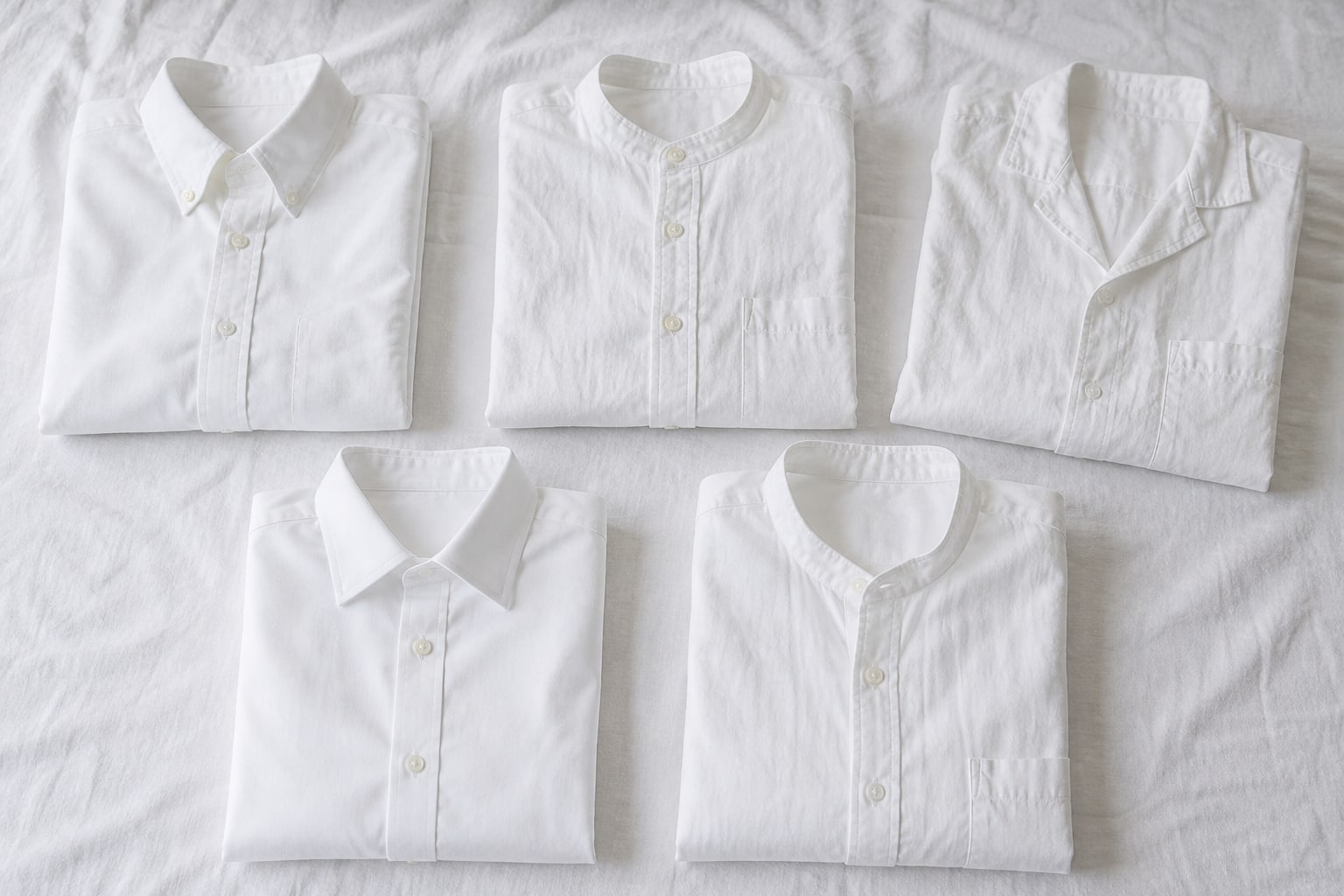
Not all white shirts serve the same function, and part of the answer to “how many do I need?” lies in understanding that it’s not about four identical copies, but about variants:
- Classic fitted shirt, for the office and formal looks.
- Oversize or boyfriend shirt, for casual and street looks.
- Stiff poplin shirt, the most versatile and easiest to iron.
- Cotton shirt with elastane, comfortable for everyday wear and wrinkles less.
- Shirt with details (ruffles, high neck, puff sleeves), for an extra styling touch without leaving white.
Having at least two different types—a classic one and a more casual one—broadens the real use of each unit without needing to buy more just for the sake of it.
How to care for a white shirt so it lasts longer (and you need to buy less)
Care directly affects how many units you need. A well-treated white shirt can last for years; poorly washed, it loses its whiteness in a few months.
A few guidelines that make the difference:
- Wash white shirts separately, never with colored items that could dye them.
- Avoid the dryer if the fabric is delicate: heat sets sweat stains and yellows faster.
- Use a specific stain remover on the collar and cuffs before putting it in the washing machine, not after.
- Let it air dry and avoid prolonged direct sun exposure, which yellows the fibers over time.
If you have doubts about which fabric composition ages best, it may help to review the difference between silk, satin and charmeuse, especially if you’re considering a white shirt in a more delicate fabric for special occasions.
Signs it’s time to replace your white shirt
There comes a moment when, no matter how much care you give it, the white shirt no longer looks right. Check these signs before deciding whether you need one more unit or simply need to replace one:
- The white has turned a yellowish or greyish tone that doesn’t come out even with special washing.
- The collar and cuffs show visible wear, even though the rest of the fabric is fine.
- The fabric has become translucent in the chest or back area.
- It has lost structure: it hangs shapeless no matter how much you iron it.
Once a shirt reaches this point, it doesn’t count toward the real tally of your wardrobe, even if it’s still hanging there. Replacing it is what keeps the number of truly useful white shirts within the range you need.
In short: your magic number
If we had to settle on a single figure, it would be this: 3 white shirts cover most lifestyles, as long as they are good quality and you care for them well. Go up to 5 or 6 if your job demands them daily; go down to 2 if your routine is mostly casual.
What matters is not accumulating, but making sure each shirt serves a clear purpose: one for day to day, another for the office, and a third reserved for when the details truly matter.